









Why will data quality decide the future of product AI?
On November 15, 2025, Nature published a study that should come as a shock to every sector relying on generative AI (e-commerce included).
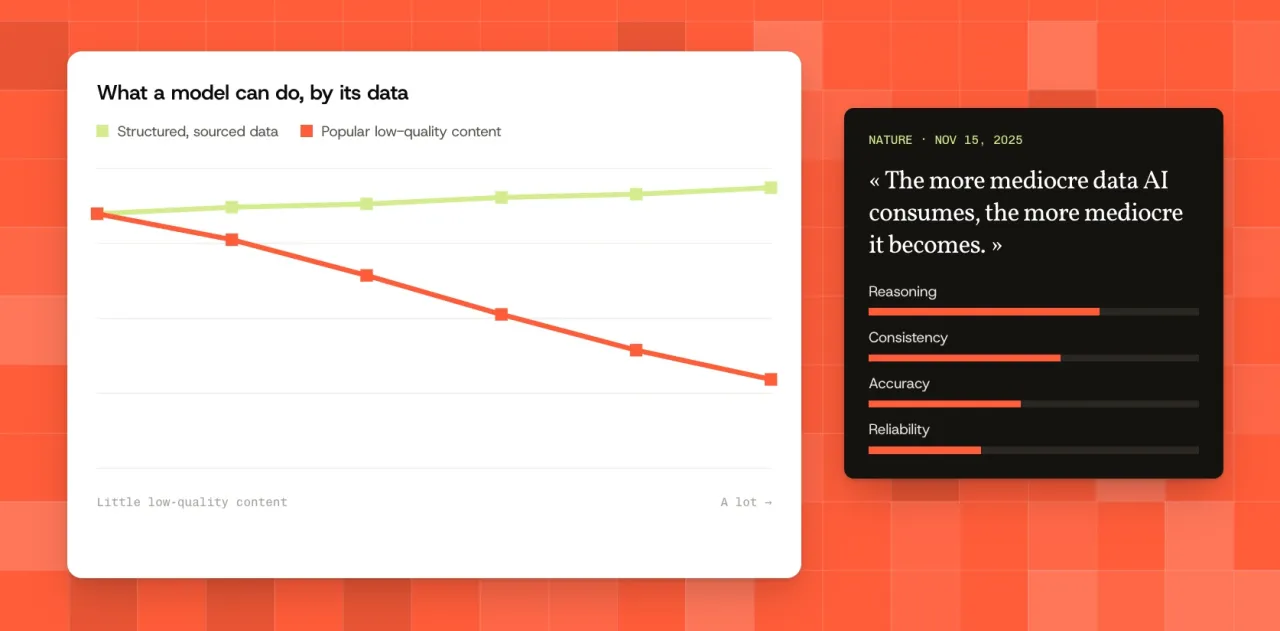
According to the researchers, feeding AI models large amounts of popular but low-quality content significantly degrades their reasoning, consistency, accuracy and reliability.
In other words: the more mediocre data AI consumes, the more mediocre it becomes itself.
This conclusion, with major stakes for the industry, opens an essential debate: how do we ensure that the AIs generating our product content, attributes, visuals or recommendations do not rely on a biased or incomplete foundation?
The warning sign: AI learns… what it is given
The study shows that when models are exposed to data that is:
- superficial,
- duplicated,
- inconsistent,
- factually approximate,
- or dominated by “mainstream” content at the expense of technical sources,
their performance drops.
The effect is cumulative: AI internalizes errors, amplifies them and carries them into everything it produces afterward.
People thought this could be fixed by “over-training”. The study shows the opposite: the noise spreads.
Why does this discovery directly concern e-commerce?
Every day, the web produces:
- short descriptions,
- missing attributes,
- approximate titles,
- outdated supplier pages,
- product data that is inconsistent from one channel to the next,
- non-standardized visuals.
This noise is precisely what general-purpose models (ChatGPT, Claude, Gemini) absorb when they try to generate or complete a product page.
The result:
➡️ hallucinations about materials,
➡️ mix-ups between models in the same range,
➡️ invented incompatibilities,
➡️ attributes inferred instead of verified,
➡️ incorrect categorizations.
And in retail, a “small” hallucination is never harmless: it can lead to poor listing, poor filtering, a poor recommendation or simply a customer return.
3. The direct link with conversational AI (GEO)
AI engines, whether called “advanced chatbots”, “conversational agents” or “GEO engines” (Generative Engine Optimization), rely entirely on the quality of the available product data.
An AI agent does not guess. It associates. So if a product lacks:
- its dimensions,
- its composition,
- its use,
- its normalized attributes,
- readable visuals,
- structured text,
then this information can never appear in a recommendation, a comparison or a conversational answer.
A poorly documented product is an invisible product in the AI economy.
This is the new GEO paradigm: the intrinsic quality of product data becomes a determining factor for future visibility in AI engines.
The study confirms a key point: product data becomes a strategic asset
For a long time, the prevailing message was: “AI will write, all we have to do is check.”
The study points to a much more demanding reality: AI will never do better than the quality of the data it relies on.
For brands and retailers, this means:
- 01Make supplier data reliableformats, standards, attributes
- 02Harmonize reference data
- 03Address the technical debtaccumulated across thousands of products
- 04Adopt automated processesthat are repeatable and controllable
- 05Ensure complete consistencyacross every channel
It is a cultural change as much as a technical one.
Why does this validate the structured approach to product content?
Faced with these challenges, a general-purpose AI is not the answer: it hallucinates as soon as data is missing.
The challenge is not to produce “text” or “attributes”, but to produce content that is:
- accurate,
- complete,
- compliant,
- proven,
- consistent,
- usable,
- and ready for every integration.
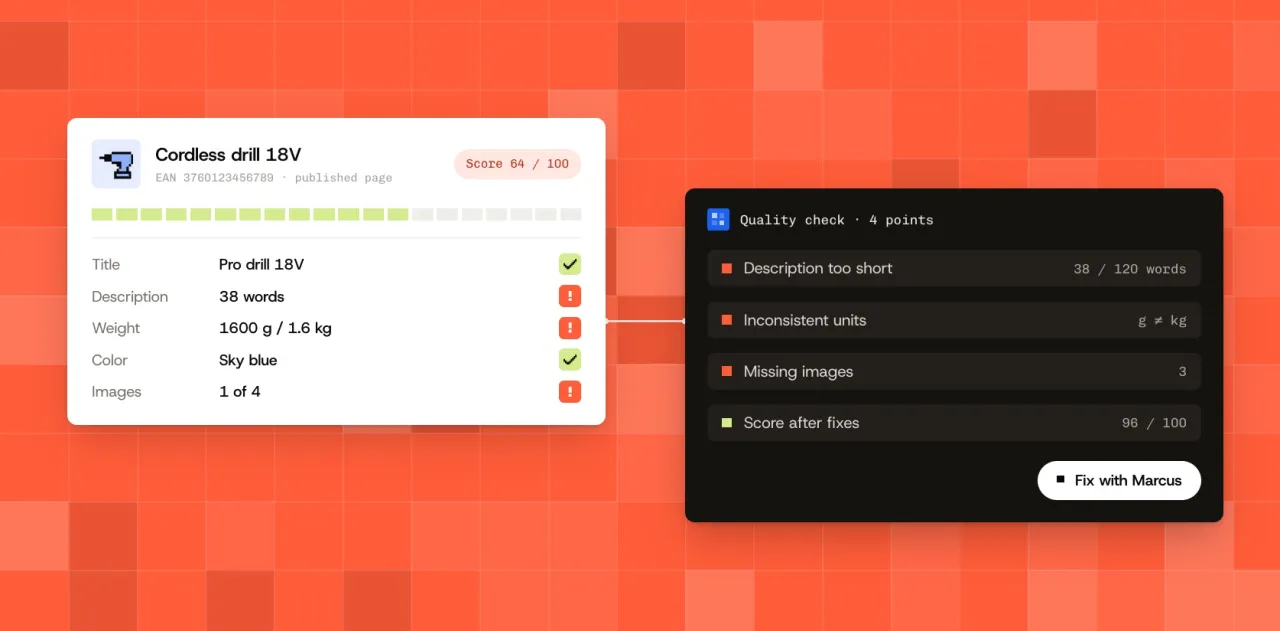
That is exactly the role of a specialized approach: ingesting supplier files, detecting errors, harmonizing attributes, cross-checking reliable sources, rebuilding a reference dataset, and only then generating automatically and cleanly.
In the new AI landscape, this approach is no longer a nice-to-have: it becomes the only way to truly benefit from AI without suffering its drift.
The battle for quality starts now…
This study is a turning point. Because it states clearly that:
➡️ data quality will determine AI quality,
➡️ the SEO battle is becoming the GEO battle,
➡️ AI engines will favor perfectly described products,
➡️ product enrichment can no longer be a craft, it must be systemic.
Companies that tackle their content debt now will gain several years’ head start. The others will let AI “guess”… and therefore get it wrong.
 Marcus





 Amazon