



Fashion and accessories
In store, you try it on.
Online, you read the page.
Relaxed or slim fit, wool or synthetic, machine washable or not, shoes that run small: in store, the sales assistant answers and the fitting room does the rest. Upsellr writes product pages that answer just as well, with the brand’s data, across your whole catalog.
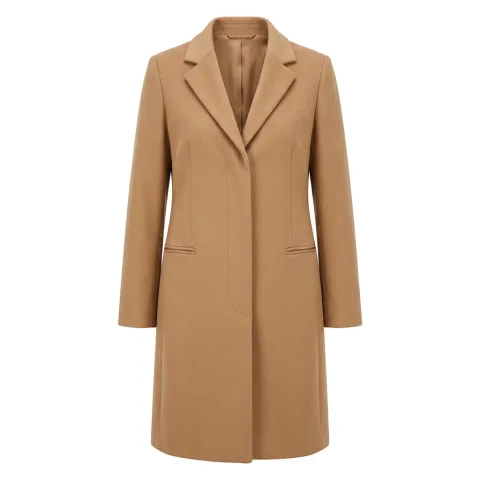
Straight-cut wool-blend coat, fully lined, below-the-knee length
For the city, from autumn to spring: a straight cut that goes over a suit jacket or a chunky jumper without pulling at the shoulders.
What it changes once you wear it
- Tightly woven wool: keeps the wind out
- Full lining: the sleeves stay in place
Specifications
- Fabric composition
- 70% wool, 30% polyamide
- Fit
- Straight
- Care
- Dry clean only
- Size
- XS to XL
What the customer would ask in store
- “Can I wear it over a jacket?”
- “Is it warm?”
- “Can it go in the washing machine?”

01The aisle’s challenges
What they couldn’t try on,
they send back.
In fashion, customers buy without trying on or touching: the page has to give the size, the fabric and the care. Six situations your customers run into every day, and what Upsellr does about them.
Clothing, shoes, jewellery01
A clothing size, a shoe size, a ring size
Clothes come in S, M, L, shoes in shoe sizes, rings in ring sizes. A “42” on a jumper and on a pair of ankle boots doesn’t mean the same thing.
Attributes by categoryFrom the supplier
Size: 42
On your page
Shoe size 42 on the ankle boot, FR size 42 on the trousers: each in its own family’s attribute
The whole aisle02
Navy, marine or midnight blue
Every brand names its colors its own way. Your filters stop finding anything and the same blue hides under three names.
Harmonized units and valuesFrom the supplier
NavyMARINEMidnight blue
On your page
Color: navy blue, written the same way on every page of the channel
Womenswear and menswear03
Composition and care, before the purchase
Fabric composition and care are on the sewn-in label, rarely in the file. Customers look for them before ordering: a wool that can’t go in the machine changes everything.
Website searchFrom the supplier
Gray marl roll-neck jumper
On your page
Composition: 80% wool, 20% polyamide. Care: hand wash, found on the brand’s website
Womenswear04
Neckline and length show in the photo
V-neck or crew neck, short or long sleeves, short or midi dress: these are the customer’s filters, and the file almost never gives them. The enrichment agent reads them from the product photos, for you to approve.
Photo analysisFrom the supplier
Floral viscose dress
On your page
Neckline: V-neck, length: midi, short sleeves, read from the product photos
Jewellery, watches, eyewear05
925 silver, gold-plated or steel?
On jewellery, the metal sets the price; on sunglasses, the lens category sets the protection. The supplier slips them into a product name, the page has to put each one in its place.
Structure the catalogFrom the supplier
Silver zircon ring S54
On your page
Metal: 925 silver, stone: cubic zirconia, ring size: 54
Fashion marketplaces06
Zalando, Amazon: their rules, not yours
Every fashion marketplace has its own categories, sizes and mandatory attributes. A listing without composition or size doesn’t go live.
MarketplacesFrom the supplier
Category: Coats
On your page
Filed in the marketplace’s category tree, composition and sizes filled in, exported in its template
02The Fashion library
Everything a fashion product page needs,
ready to go.
Upsellr gives you a library built for fashion and accessories: the aisle’s product families, from ready-to-wear to sunglasses, each family’s attributes with their units and value lists, and the fields that make up a product page in the sector. Your Fashion channel starts with it, with nothing to model.
- 10product families
- 42attributes, from fit to shoe size
- 34ready-made value lists
- 4page fields, each with its instructions
 Marcus
Your channel receives the sector library: its families, their characteristics and their value lists.
The sector’s page template arrives with its sections, each with its own expert instructions.
Every generated page follows this template, with your product’s data.
03The aisle’s tone
How it fits,
not how it makes you dream.
Precise and understated, never magazine copy: the reader wants to know how the product hangs, holds up and is cared for.
This timeless, refined coat will elevate every outfit! An absolute must-have to take on winter in style.
Straight-cut wool-blend coat, below-the-knee length. The cut goes over a suit jacket without pulling at the shoulders. Full lining: the sleeves stay in place. Dry clean at the end of the season.
Do
- Named fabrics: “tightly woven wool”
- The cut, the length and what the piece goes over
- The season and the care the fabric needs
- Brand data written as such: “stated composition”
Avoid
- Superlatives and exclamation marks
- Trend vocabulary: “must-have”, “timeless”
- Any value missing from the sources
04In the sector
From showroom to fitting room,
four ways to sell fashion.
 Wholesalers and multi-brand agentsCollections from dozens of brands every season, in Excel, CSV or PDF catalogs.
 Multi-brand boutiques and online storesNew collections online when they reach the shop floor, not three weeks later.
 Ready-to-wear and accessories brandsThe same composition and the same sizes at every reseller and in every language.
 Retail chains and store networksThe same product standards on the website, in store and on fashion marketplaces.
Your questions.
Straight answers.
What you need to know before you start.
Does Upsellr handle clothing sizes, shoe sizes and ring sizes?
Yes. The Fashion library keeps them apart: size for clothing, shoe size for shoes, ring size for rings, each with its own value list. A “42” on a jumper and on a pair of ankle boots doesn’t end up in the same attribute.
Where does Upsellr find composition and care?
In the brand’s file when they’re there, otherwise on its website or in its PDF sheets, and every value found keeps its source. A composition that can’t be found isn’t made up: the page doesn’t mention it.
My collections change every season: do I have to start over?
No. Each new collection is imported like a supplier file: columns are recognized, the enrichment agent completes the master data, the generation agent writes your channels’ pages. You approve before anything goes live.
I also sell on Zalando or Amazon: how does that work?
Each marketplace listing is written to the channel’s rules: category, mandatory attributes, value lists. Connectors are on their way; in the meantime, the listing exports in the marketplace’s template.
My store already has its categories: what happens to the sector library?
It’s a starting point while your store can’t be read yet. As soon as your store or your PIM is connected, your own categories apply, and you can add your own attributes.
Other sectors
Your fashion aisle,
with pages that fit just right.
Try it on your products or see Upsellr on your aisle in a personalized demo.





 Amazon