









Mapping product data: understanding the product data journey
When people talk about "product data", it often sounds like a single block.
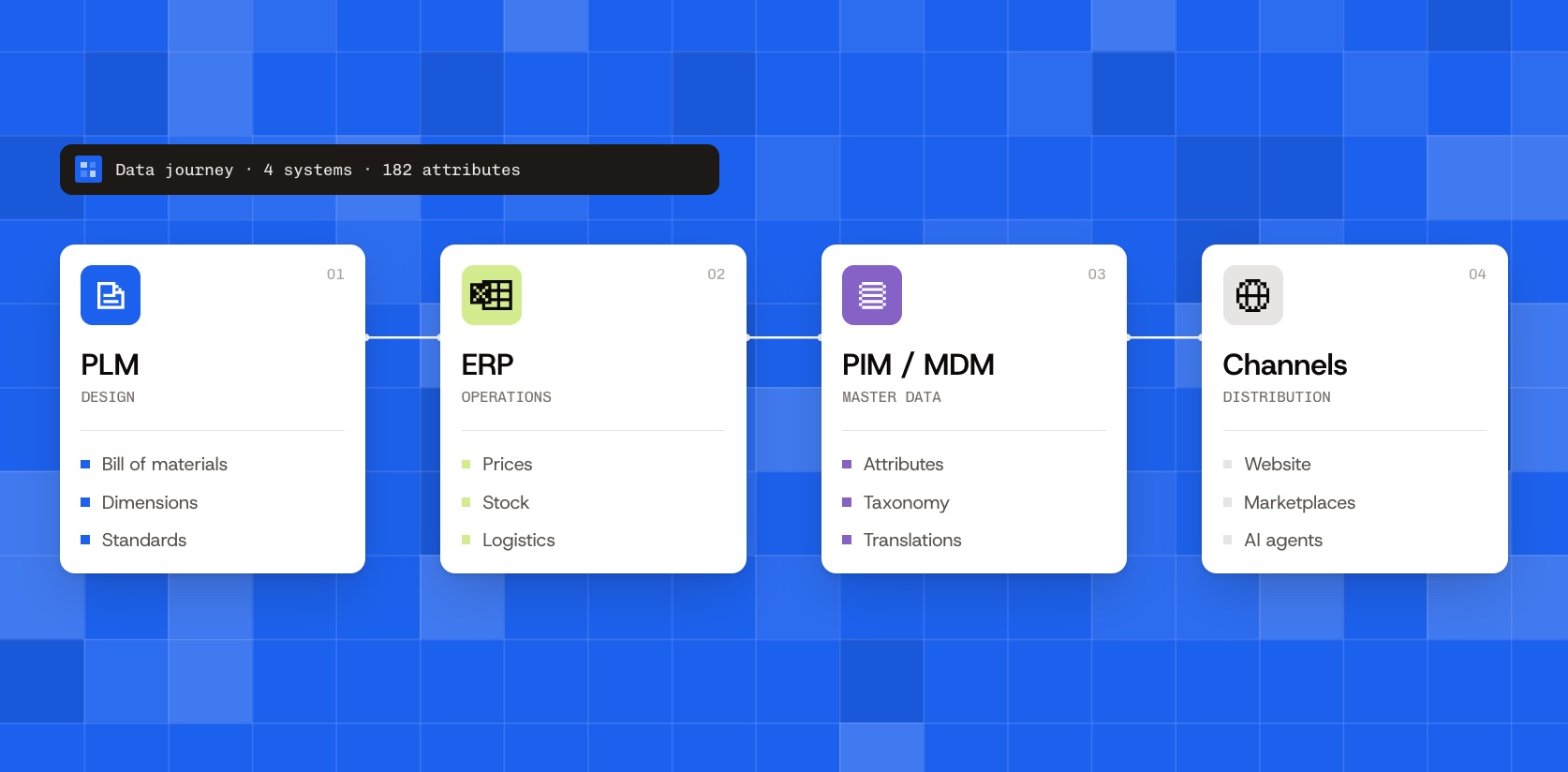
When people talk about “product data”, it often sounds like a single block. In reality, product data is a flow that passes through several systems, several teams and several levels of maturity before it reaches the customer.
To understand where friction arises and where AI truly changes the game, you first need to map this journey.
In most e-commerce and retail organizations, the product data chain follows four main stages, not always named as such, but which can be summed up as: PLM, MDM, PIM, then the distribution channels, sometimes with feed managers in between
1. PLM: where product data is born
PLM (Product Lifecycle Management) is the starting point.
This is where the product is designed:
R&D, engineering, industrial specifications, bills of materials, regulatory constraints, materials, dimensions, standards.
👉 The data here is:
- very rich
- very precise
- but designed for manufacturing, not for selling
At this stage, the product exists technically, but it is not yet usable by e-commerce or marketing teams.
AI agents can start playing a discreet but useful role here: extracting, structuring and rewording complex technical information to make it understandable downstream.
2. MDM: make it reliable and unified
MDM (Master Data Management) is often the least visible building block… and yet the most foundational.
It is the backbone of the data.
This is where you:
- harmonize reference data
- clean up duplicates
- normalize attributes
- unify units, values and labels
- guarantee a single version of the truth
Without a solid MDM, each system interprets the data in its own way.
AI agents are particularly effective at this level to:
- detect inconsistencies and anomalies
- reconcile heterogeneous sources
- automatically enrich missing fields
- continuously check data quality
This is a key stage: before accelerating with AI, you need to make data reliable.
3. PIM: make the data commercially usable
PIM (Product Information Management) is the e-commerce cockpit.
This is where data becomes:
- descriptive
- understandable
- comparable
- sellable
Product descriptions, marketing attributes, SEO, translations, variants, rules per channel…
This is also where the operational workload explodes once catalogs exceed a few hundred or even thousands of products.
AI agents profoundly transform this stage:
- generating consistent content from structured data
- automatically enriching attributes and visuals
- adapting content to channels, languages or markets
- running quality checks before publication
It is no longer just about “producing faster”, but about maintaining quality at scale.
4. Channels: where data is consumed
The last stage: the channels.
E-commerce sites, marketplaces, apps, print catalogs, partner feeds… And now, enriched search engines and conversational AI.
Each channel imposes:
- its own formats
- its own rules
- its own structuring requirements
At this level, AI agents:
- transform data for each channel
- automate feed updates
- check compliance
- feed engines able to recommend, compare and respond to usage intents
👉 The quality of product data directly determines visibility, conversion and trust.
5. And where do feed managers fit in?
Between the PIM and the channels, many organizations now rely on feed managers (Channable, Lengow, Feed Manager, etc.).
Their role is clear: adapt, transform and distribute product data to a multitude of platforms (marketplaces, comparison sites, social commerce, partners, ad networks, and now AI engines).
They play a key role in:
- mapping attributes to the schemas each channel expects
- applying transformation and prioritization rules
- managing feed variants at scale
- maintaining continuous, controlled distribution
But feed managers have a structural limitation: they do not create data. They orchestrate it.
If the incoming data is incomplete, inconsistent or poorly structured, the feed manager merely reconciles approximations.
This is where pairing them with AI agents upstream becomes critical.
Agents positioned between MDM and PIM, then between PIM and feed managers, make it possible to:
- enrich attributes before distribution
- make key values reliable (units, compatibilities, uses)
- prepare “AI-ready” feeds that are consistent and usable by every channel
In a world where channels are multiplying and AI engines themselves are becoming feed consumers, the feed manager remains essential, but it depends more than ever on the quality of upstream data.
👉 Performance is no longer decided in the final transformation, but in the ability to deliver clean, structured, purposeful data before distribution.
In summary: a continuous chain, not silos
This map can be summed up simply:
- PLM: make the product
- MDM: make the data reliable
- PIM: showcase the product
- Channels (with or without feed managers): distribute and sell
What AI reveals today is that product data has become the main limiting factor in e-commerce performance.
AI agents do not replace these building blocks.
They run through them.
They connect them.
And above all, they make their weaknesses immediately visible.
So the real question is no longer just a technological one.
👉 Where does your product data stand in this chain?
👉 And at what point does it become a lever… or a brake?
That is the condition for AI to truly create value, sustainably.
 Marcus





 Amazon