









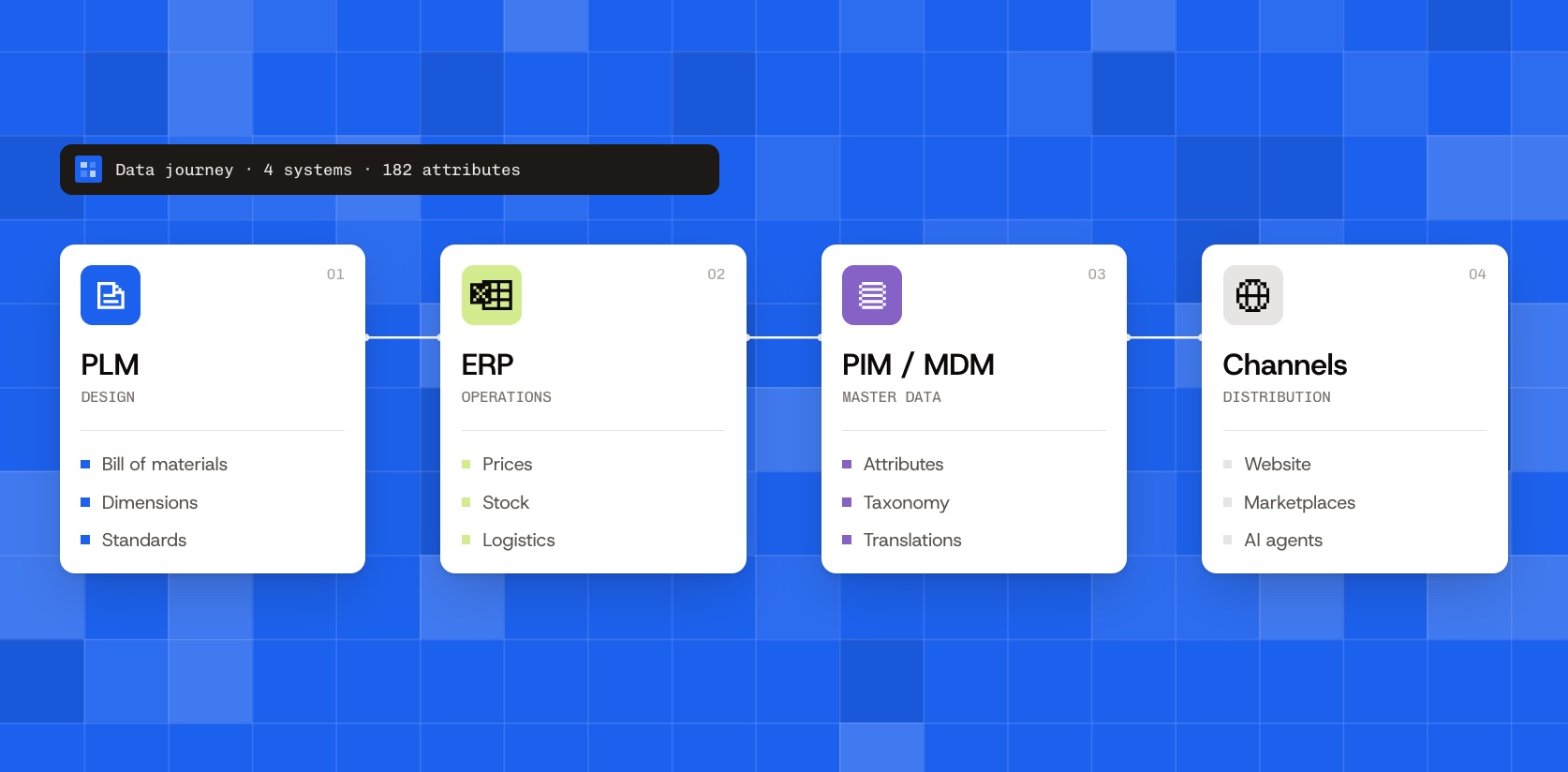
Product Content Intelligence: product pages as the native language of AI agents
Beyond SEO and UCP: how to turn your product data into a lasting competitive advantage in the age of agentic commerce
The invisible paradox of agentic commerce
January 2026. Google and Shopify launch the Universal Commerce Protocol (UCP), an open standard backed by Walmart, Target, Etsy, Mastercard and some twenty other major players.
At the same time, OpenAI is rolling out its Agentic Commerce Protocol (ACP). McKinsey publishes an exhaustive analysis of “the agentic commerce opportunity”. Harvard Business Review devotes several articles to the subject. The message is clear: AI agents will not just recommend your products, they will buy them for your customers.
At this stage, UCP and ACP are not yet widely deployed standards in production. We are in a phase comparable to SEO between 2000 and 2003: few players are already getting an operational benefit from it, but the technical and conceptual foundations are now in place.
So the challenge is not immediate adoption, but preparing catalogs for a world where these protocols will become the norm.
Yet behind this enthusiasm lies a paradox that few players dare to put into words: an AI agent can only buy what it can understand.
As the INSEAD team points out in its analysis for HBR, we are witnessing a fundamental shift of power in the brand-retailer-consumer relationship.
For 20 years, e-commerce platforms captured value by owning customer data. Tomorrow, it will be the brands and retailers that master Product Content Intelligence who define what gets discovered, compared and bought.
Of course, product data does not replace the brand, logistics or commercial policy. An AI agent will continue to factor in signals of price, availability, retailer reputation and service quality.
But unlike those levers, product data is today the only asset that agents can directly read, compare and act on, and therefore the first visibility filter in agentic environments.
From SEO optimization to agentic intelligibility
What is fundamentally changing
For 25 years, e-commerce has optimized for a single audience: the human consumer who reads, clicks and browses. Product pages were designed to catch the eye, the title to grab attention, the visual to spark emotion.
Today, according to a Harvard Business Review Analytic Services study cited by Coveo, 65% of decision-makers consider generative AI “very important” to their e-commerce operations. But only 31% have active GenAI use cases, revealing a gap between strategic vision and execution.
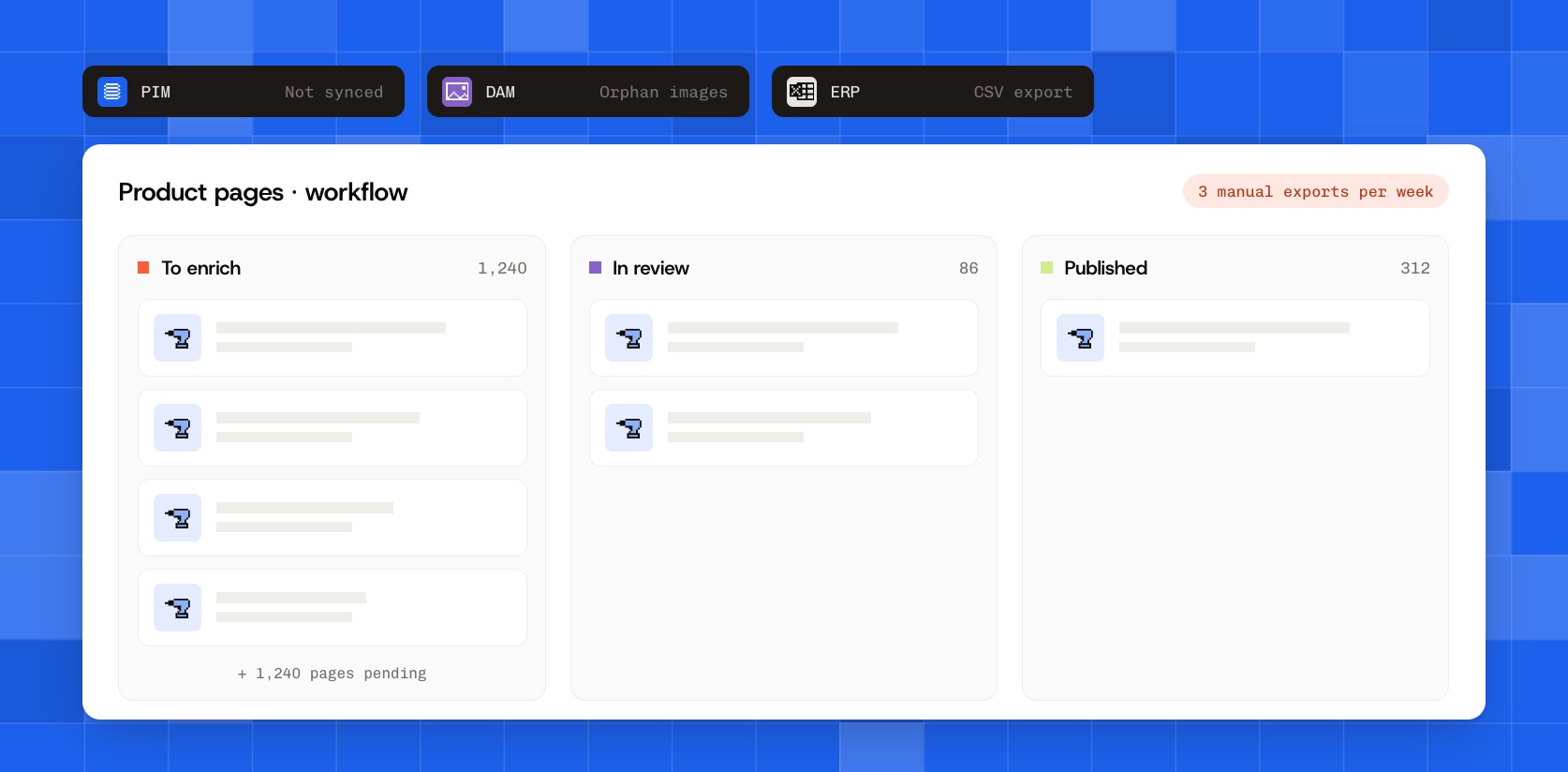
The reason? Most product catalogs are simply not readable by AI agents.
The three dimensions of agentic intelligibility
Our work with hundreds of e-commerce catalogs has allowed us to identify three successive layers of optimization:
1. Structuring (the technical foundation)
- Machine-readable data via API (JSON, REST)
- Schema.org and enriched metadata
- Normalized taxonomies and consistent hierarchies
- Unique, stable product identifiers (GTIN, SKU)
2. Contextualization (the semantic layer)
- Product attributes in natural language, not technical jargon
- Relationships between products (compatibilities, substitutes, complements)
- Explicit usage contexts (“for what need”, “in what situation”)
- Trust signals (verified reviews, certifications, warranties)
3. Disambiguation (optimizing for inference)
- Clarifying terms with multiple meanings in your field
- Spelling out the differences between variants
- Ruling out inappropriate use cases
- Intent metadata (“best for X”, “avoid if Y”)
A recent study published on arXiv tested the shopping agents of GPT-4, Claude Sonnet and Gemini on thousands of simulated transactions. A striking result: all models show position bias (they favor certain positions in product lists), but above all, they heavily penalize products whose information is ambiguous or incomplete.
Models’ reasoning abilities are progressing quickly, and some content that is ambiguous today will likely become partly usable tomorrow.
But in a transactional context, the agent is penalized not on what it can infer, but on the risk of error it has to take on. The more explicit a piece of information is, the less the agent has to compensate with uncertainty, and the more inclined it is to recommend or buy.
UCP and GEO: two sides of the same revolution
The Universal Commerce Protocol: the infrastructure of agentic commerce
As Google’s technical documentation details, UCP is not just a payment protocol. It is a common language that standardizes:
- Discovery (how an agent finds your products)
- Capabilities (what your backend can do: checkout, cart, loyalty, etc.)
- Extensions (your specifics: promotions, subscriptions, configurator)
- Payment handlers (secure multi-PSP integration)
Unlike conventional e-commerce integrations that require months of custom development, UCP lets any compatible agent connect to your catalog in a few hours.
The strategic implication: if your products are not accessible via UCP (or ACP, its OpenAI equivalent), you will in effect be invisible in Google Gemini, ChatGPT and every shopping agent to come.
GEO (Generative Engine Optimization): the SEO of the agentic era
GEO refers to optimizing your content to be cited by generative engines (ChatGPT, Perplexity, Google AI Overviews, Gemini).
Unlike classic SEO, which aims for ranking (position in the results), GEO aims for citation: being the source the AI uses to build its answer.
GEO success factors according to Search Engine Land and leading practitioners:
- Reinforced E-E-A-T: Expertise, Experience, Authoritativeness, Trustworthiness
- Heavily enriched structured data: Schema.org Product, FAQPage, Review, etc.
- Retrieval-friendly content: chunkable text, clear context, easily extracted attributes
- Cross-platform consistency: the same information on your site, Google Merchant and marketplaces
An analysis by BrandRadar shows that brands with a high GEO score get up to 300% more citations in AI answers than their direct competitors.
GEO and AAO are not entirely new disciplines, but the natural evolution of existing practices (SEO, data quality, information architecture) adapted to a new audience: the AI agent.
What changes is not so much the nature of the work as the criterion for success: you no longer optimize for the human click, but for understanding, citation and automated decision-making.
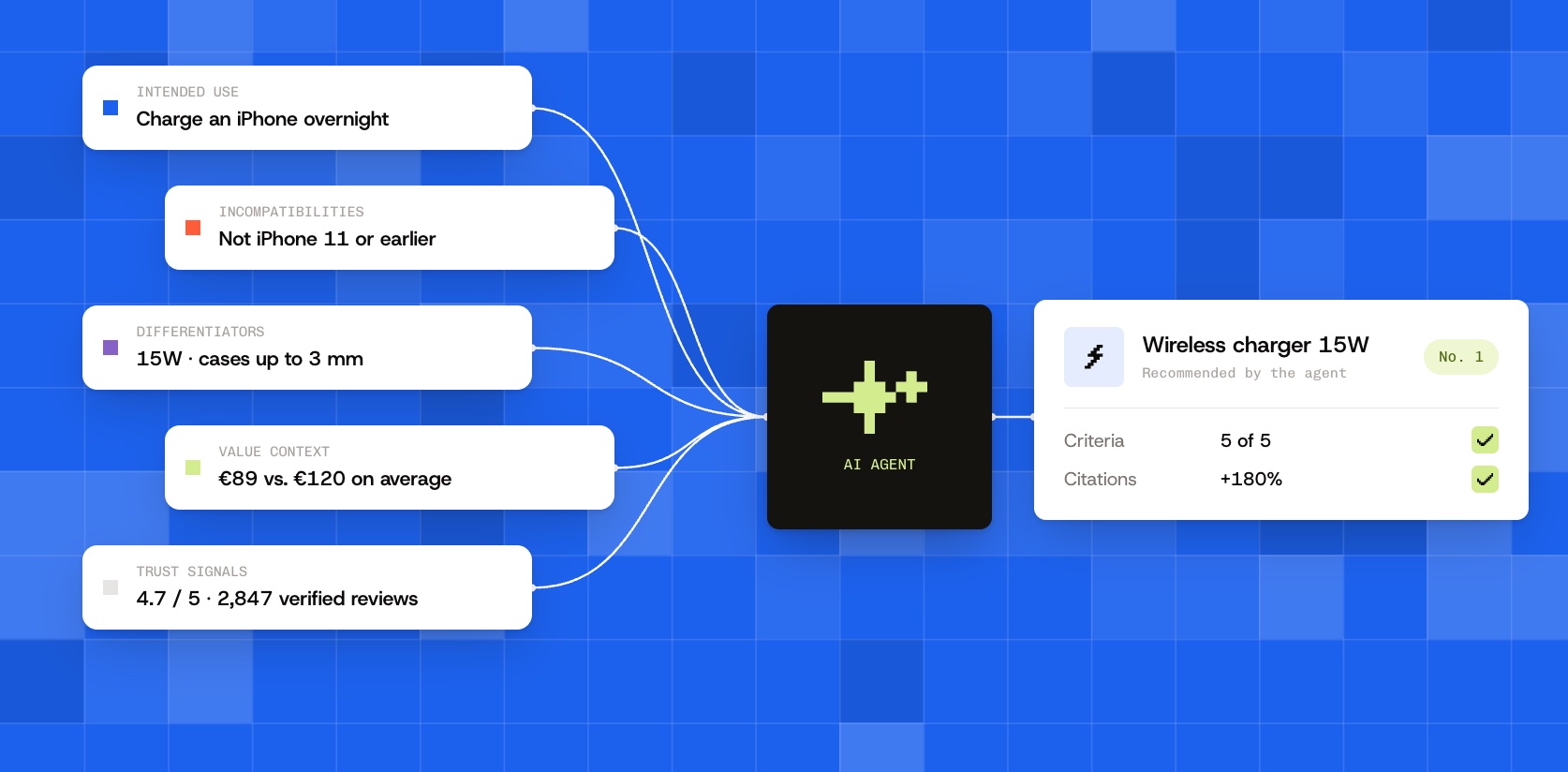
The 5 critical product attributes for agents (with concrete examples)
Based on our tests with GPT-4, Claude and Gemini, here are the 5 dimensions every product absolutely must clarify:
1. Explicit intended use
Bad: “15W wireless charger, sleek design”
Good: “15W wireless charger for iPhone 12-16 and Samsung S21+, works with cases up to 3mm thick, ideal for desk and nightstand”
Why: Agents are trying to solve a need (“charge my iPhone while I sleep”), not to buy a product.
2. Explicit incompatibilities
Bad: “Compatible with most smartphones”
Good: “Compatible: iPhone 12-16, Samsung S21+, Google Pixel 6+. Not compatible: iPhone 11 and earlier, thick MagSafe cases (>3mm), phones with a PopSocket”
Why: An agent will always prefer certain negative information to the risk of an error.
3. Measurable differentiators
Bad: “Ultra-light, durable suitcase”
Good: “55cm suitcase (2.8kg empty), reinforced polycarbonate, tested over 10,000 cycles, 10-year warranty, meets Ryanair/EasyJet cabin requirements”
Why: Agents compare attributes, not marketing promises.
4. Value context
Bad: “From €89”
Good: “€89 (vs. €120 market average for an equivalent), saves €15/month in electricity vs. a standard model, pays for itself in 8 months”
Why: AI agents are programmed to assess value for money factually.
5. Verifiable trust signals
Bad: “Best product in its category”
Good: “4.7/5 from 2,847 verified reviews, CE and RoHS certified, named Best Choice by 60 Millions de Consommateurs (01/2026), return rate <2%”
Why: LLMs are trained to favor verifiable sources and avoid hallucinations.
Real cases: the first winners of agentic commerce
Case 1: Technical products distributor (B2B)
Starting point: 45,000 SKUs, product pages generated automatically from manufacturer specs
Actions:
- Natural-language enrichment: “M6 x 20mm zinc-plated steel screw” → “M6 x 20mm machine screw, hex head, zinc-plated steel (moisture resistant), fully threaded, fits M6 nut, indoor/outdoor use, max load 150kg”
- Added usage contexts: “Ideal for fastening metal furniture, steel gates, workshop shelving”
- Incompatibilities: “Not suitable for: softwood (use wood screws), aluminum (use stainless steel), critical load-bearing structures”
Results after 3 months:
Case 2: Cosmetics brand (DTC)
Starting point: Strong marketing content, but thin product data
Actions:
- Restructured attributes: INCI ingredients in plain language, benefits with clinical studies cited
- On-page GEO: structured FAQ, Schema.org Product + Review + HowTo
- Compatibility matrix: “Suitable for sensitive/oily/dry skin”, “Compatible with [complementary products]”
Results after 4 months:
- Appearing in 23% of “best cream for sensitive skin” queries on Google AI Overviews (vs. 0% before)
- +95% traffic from Perplexity
- Return rate cut in half (better product-need fit)
The 3 fatal mistakes to avoid
Mistake 1: Believing UCP/ACP is enough
Implementing UCP without enriching your product data is like opening an API to an empty catalog. The agent will technically be able to buy… but will never recommend your products because it cannot understand or compare them.
Mistake 2: Applying SEO recipes to GEO
GEO is not “SEO for ChatGPT”. Where SEO optimizes for the click (CTR, catchy meta description), GEO optimizes for factual citation. A clickbait title or a vague marketing description reduces your chances of being cited.
Mistake 3: Waiting for it to “mature”
According to McKinsey data, agentic commerce will account for between 15% and 30% of e-commerce transactions by 2028. But as Bain & Company points out in HBR, AI agents learn from what they have already consumed. The brands ChatGPT cites today are building a compounding advantage: every citation strengthens their authority for future citations.
This transformation goes well beyond the scope of any one tool or software vendor. It concerns product teams, PIMs, search engines and marketplaces as much as agencies and platforms.
Whatever solution you choose, the central challenge remains the same: making product data intelligible, comparable and usable by autonomous systems.
Conclusion: data quality as a lasting competitive advantage
Agentic commerce is not a “new e-commerce trend”. It is a paradigm shift in how products are discovered and bought.
In this new world:
- The winner is whoever speaks the language of agents (structured data, rich context, trust signals)
- The loser is whoever relies solely on traditional SEO, advertising campaigns and brand awareness
As the INSEAD research team sums it up: “AAO (AI Agent Optimization) will become a discipline as critical as SEO was in the 2000s. Brands that offer little tangible value beyond their name risk losing their position.”
The good news? Most of your competitors have not yet understood this. You likely have a 12 to 18 month window to build a first-mover advantage before the market standardizes.
What we do not know yet:
– The exact degree of autonomy consumers will agree to delegate to agents
– The actual speed of adoption of protocols like UCP or ACP
– The share of decisions that will remain emotional or brand-driven
What we do know, however, is that agents will learn from the catalogs they can understand today.
The question is no longer “Should we get started?” but “Which products do we start with on Monday morning?”
 Marcus





 Amazon