









Why will AI agents break through your operational ceilings?
For a long time, the question was simple: how do we do a little better, a little faster, a little cheaper?
AI was first approached as an optimization tool. An assistant. An accelerator. A “copilot”.
But what we are seeing today with AI agents is of a different order.
An AI agent does not perform an isolated task. It takes charge of a goal, operates within a given framework, iterates, corrects itself, and produces a result that remains usable over time.
The shift we see among our customers is not about the technology, but about what these agents finally make possible.
1. From constant trade-offs to full coverage
Before, every organization made the same choice, often a forced one:
work on only part of the catalog.
The best products. The priority categories. The rest waited.
Not for lack of vision, but because the human and operational cost was too high.
With AI agents able to ingest, structure and enrich data continuously, this trade-off disappears.
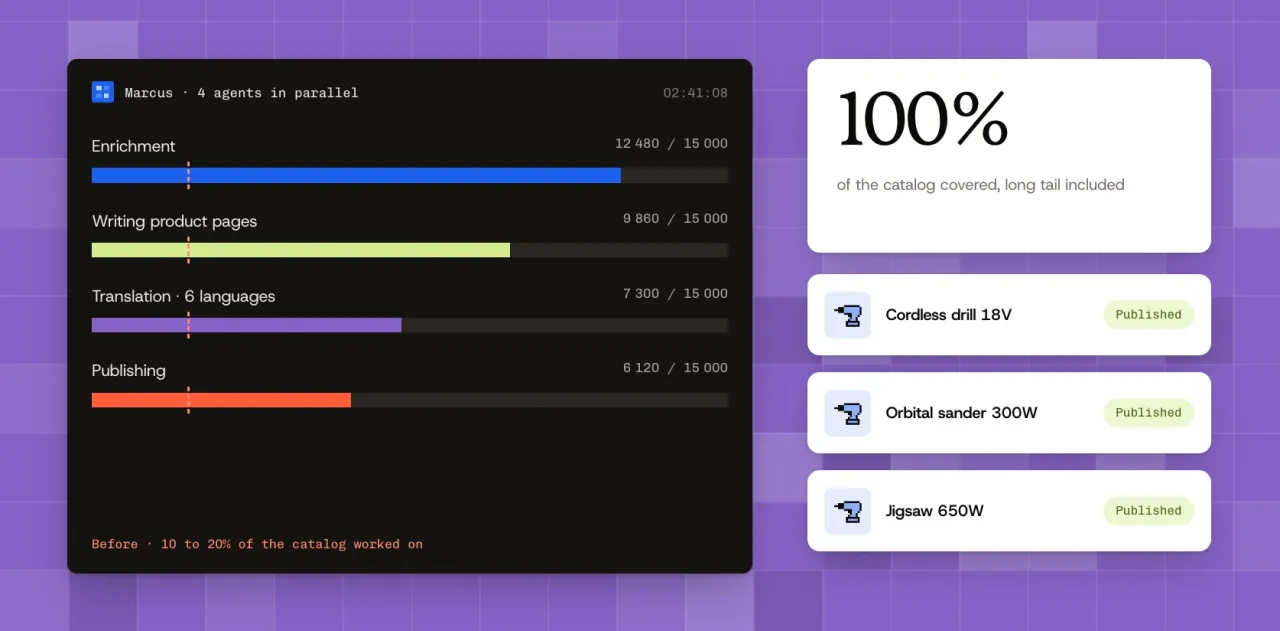
Our customers go from 10 or 20% of products actually worked on to 100% of the catalog, including the long tail, new supplier products and slow-moving SKUs.
This is not an optimization. It is a change of scope.
2. From a static product page to a manageable data asset
Historically, a product page was an editorial deliverable. A text produced, approved, then frozen.
An AI agent radically changes this logic.
It produces not only content, but above all structured data that is usable, versioned and improvable:
– normalized attributes
– fine-grained categorization
– dynamic FAQs
– multichannel content
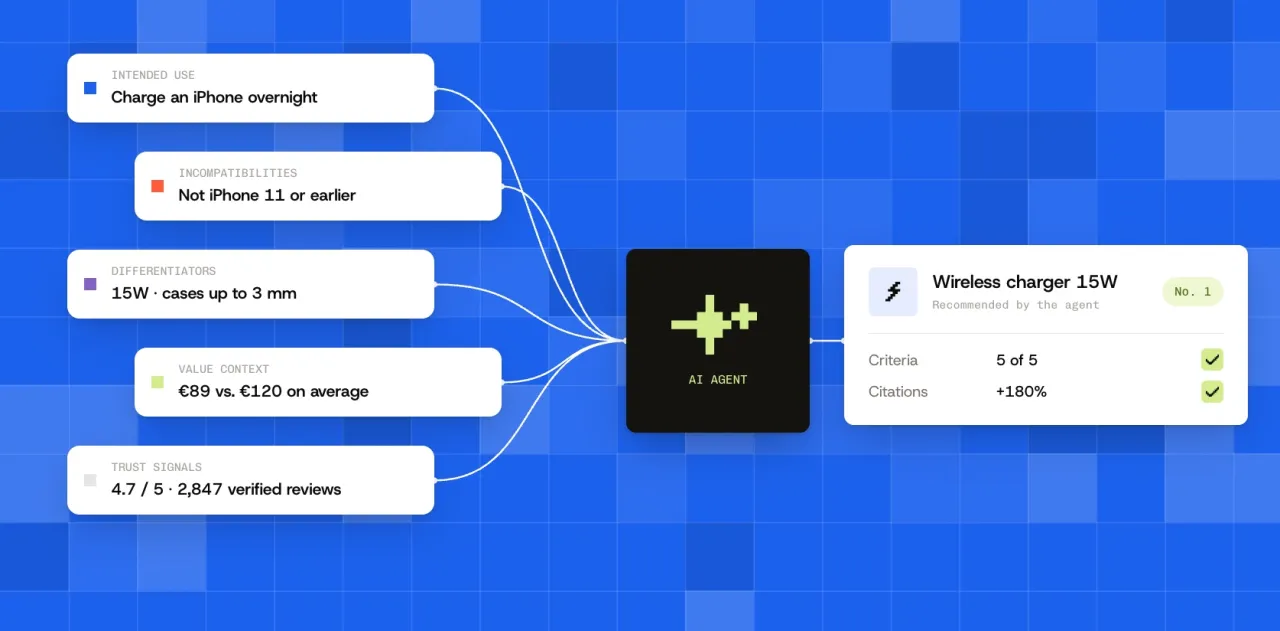
– native preparation for SEO, marketplaces and conversational engines
The product page stops being a deliverable. It becomes a living data foundation.
3. From one-off project to continuous flow
Before, product content was managed in project mode:
– heavy overhauls
– one-off mobilization of teams
– painful trade-offs
– dependence on available resources
AI agents introduce a continuous flow way of working.
They process new products as they arrive, update existing ones, and adapt to changes in taxonomy, channels or business priorities.
Content is no longer a project. It is a permanent capability.
4. From “we don’t have time” to steering by standards
This is a very strong signal we are seeing in the field.
Before, conversations started with constraints: time, budget, resources.
With operational AI agents, these obstacles fade.
The discussion shifts to:
– the expected level of quality
– confidence thresholds
– human approval rules
– data governance
In other words: the question is no longer whether it is feasible, but how to steer it well.
5. From content as a cost to content as a strategic lever
For a long time, product content was seen as a necessary expense. Hard to measure. Not very differentiating.
AI agents change that status.
For our customers, content becomes a direct lever on:
– speed to market
– organic visibility
– marketplace performance
– omnichannel consistency
– readiness for conversational search engines
Content is no longer an expense to be endured. It is a measurable strategic asset, product by product.
What decision-makers really need to ask themselves
The right question is no longer: “What can we automate with AI?”
But: “Which operational ceilings are we still accepting, now that AI agents finally let us break through them?”
That is precisely where technology stops being a tool.
And becomes a lasting structural advantage.
At Upsellr, this is exactly the change we are seeing, customer after customer.
– measurable improvement in visibility
– better conversion
– omnichannel consistency
– readiness for conversational search engines
Content stops being a cost center. It becomes a measurable business lever, product by product.
The real question for decision-makers
So the question is no longer: “what can we automate?”
But: “What have we never done until now because it was too slow, too expensive or too complex… and that finally makes sense today?”
That is precisely where AI stops being an optimization tool.
And starts creating a structural advantage.
 Marcus





 Amazon