









Agentic commerce according to Google: a new strategic framework
What Google's announcement means in practice for merchants, their product data and their sales channels
On January 11, 2026, Google published a defining announcement for the e-commerce ecosystem: agentic commerce is no longer a theoretical projection, but a deliberate product direction, with tools and standards behind it.
Beyond the words, there are above all very concrete implications for merchants, online retailers and digital leadership teams. This announcement does not describe a distant future. It describes a new operational framework that will have to be adopted quickly.
1. A change in logic: from browsing to execution
For twenty years, online commerce has been organized around a relatively stable pattern:
search → click → website → browsing → cart → payment.
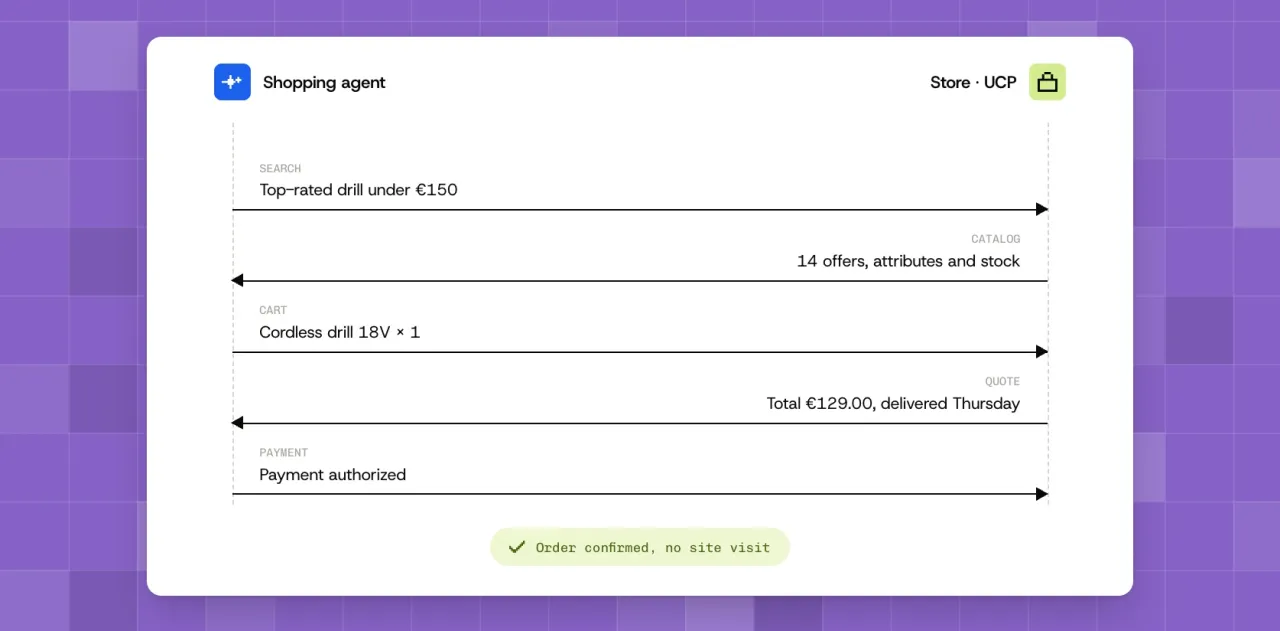
With agentic commerce, this model is evolving. Conversational interfaces and AI agents no longer just help people search or compare. They can guide the user all the way to action, including purchase, directly from the AI interface.
For merchants, this implies one essential thing:
the product must be understandable and usable without going through classic browsing.
You no longer “read” a product page, you query it.
2. The Universal Commerce Protocol: a strong signal about where the market is heading
The core of Google’s announcement is the launch of an open standard: the Universal Commerce Protocol (UCP).
Its goal is simple but far-reaching: to allow AI agents, e-commerce platforms, merchant systems and payment solutions to communicate across the entire buying journey, without integrations specific to each player.
This point is key, because it marks a shift:
- agentic commerce is no longer a pile of isolated experiences,
- it is becoming a common foundation, designed to be industrialized.
For merchants, this means agents will multiply, but they will also expect a common language, structured data and clear rules in order to act correctly.
3. The product page is no longer a page, it is a knowledge base
Another major lesson from this announcement concerns the very nature of the product page.
Google highlights new attributes and formats designed for conversational discovery:
frequently asked questions, compatibilities, accessories, alternatives, uses, constraints, etc.
This is no small detail. It means that:
- discoverability no longer relies solely on keywords,
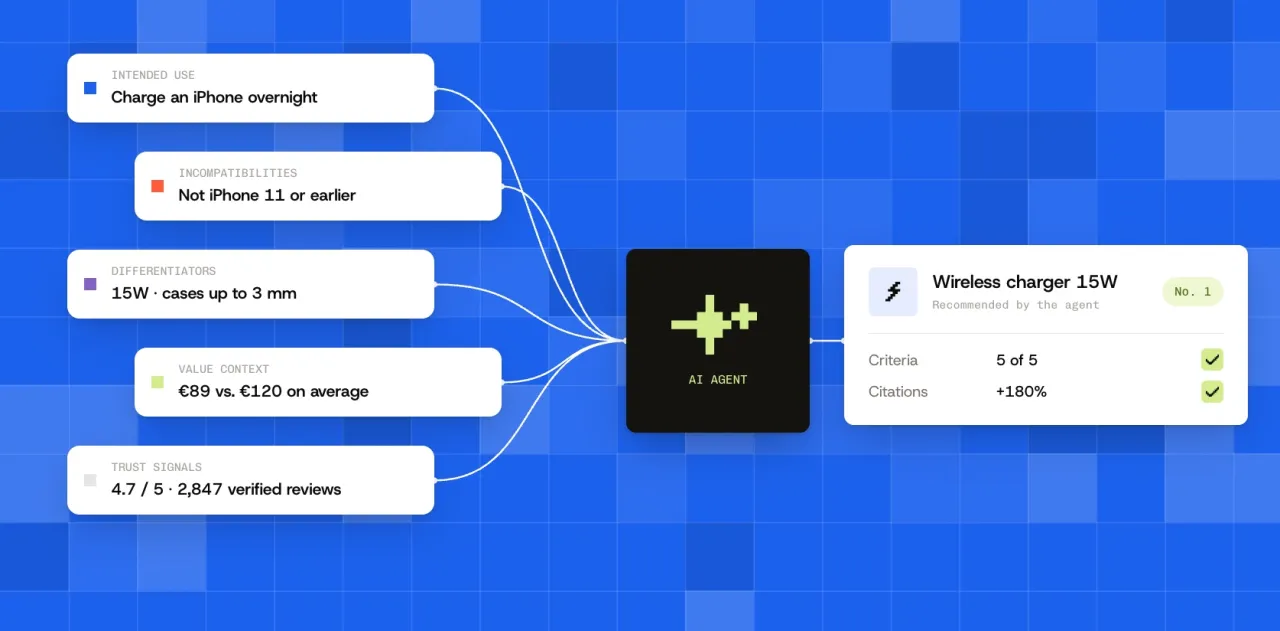
- performance depends on the product’s ability to answer intents expressed in natural language.
In an agentic environment, a product page becomes:
- a set of structured facts,
- ready-to-use answers,
- usage rules that agents can act on.
In other words, a product knowledge base, not just marketing content.
4. Brand agents set a new bar for data quality
Google is also announcing brand agents able to converse with consumers within search interfaces.
This type of agent is powerful, but it also highlights an often underestimated reality:
an agent cannot make up for approximate product data.
Without reliable attributes:
- answers are vague,
- comparisons are wrong,
- recommendations become risky.
The more the agent acts (recommends, suggests, triggers a purchase), the more critical data quality, consistency and completeness become.
5. The transaction moves closer to the moment of intent
With formats like “direct offers” in AI interfaces, the transaction can now take place at the precise moment the intent is expressed.
This reduces friction… but also increases the merchant’s responsibility:
- less time to explain,
- fewer steps to correct,
- less room for approximation.
In this context, upstream preparation becomes strategic:
- clean data,
- clear rules,
- consistent information across every channel.
6. What merchants should take away right now
This announcement does not call for “switching tools” overnight. It invites you to rethink the method.
Three priorities clearly stand out:
- Treat product data as a strategic asset, not a marketing deliverable.
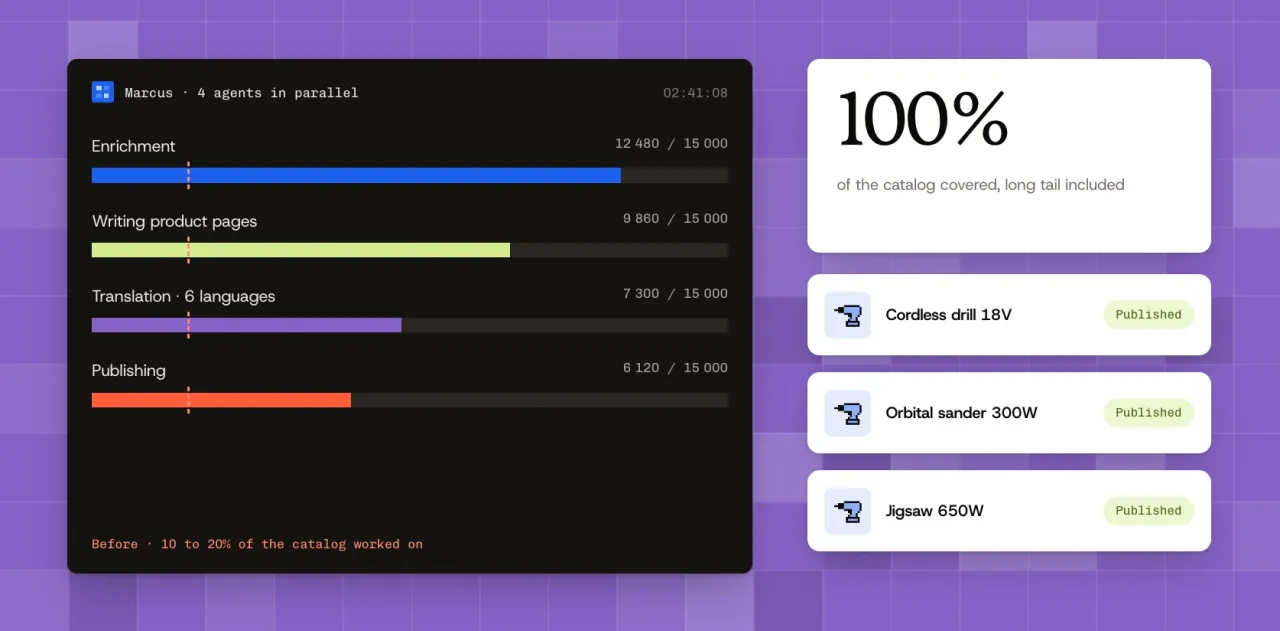
- Structure, normalize and enrich at scale, to be readable by agents, not just by humans.
- Think multichannel and agent-ready from the design stage, rather than adapting after the fact.
Agentic commerce does not replace e-commerce sites.
It adds an extra layer of execution: demanding, fast, and highly dependent on the quality of the foundations.
Conclusion
Google’s announcement marks less a technological break than a strategic clarification:
commerce is entering a phase where agents become a channel in their own right.
In this new framework, differentiation will not come solely from the interface or the marketing promise, but from the ability to provide product information that is:
- reliable,
- structured,
- actionable,
- maintained over time.
Merchants who prepare for it now will get a head start.
 Marcus





 Amazon